
Hendrix Genetics increased modeled revenue by 1.4% to 1.8% across two Brazil line benchmarks with SWARM ENGINE
Across two lines in Brazil, SWARM ENGINE compared optimized flock and egg allocation with Hendrix Genetics’ standard plan. The model completed the same benchmark orders while improving projected revenue, hatch performance, and egg utilization.

CUSTOMER
Hendrix Genetics
Hendrix Genetics is a global animal breeding and genetics company with programs in laying hens, turkeys, traditional poultry, swine, salmon, trout, and shrimp. Founded in 2005, it operates in more than 25 countries, including Brazil. This study concerns a localized poultry planning benchmark on two lines in Brazil, not the company’s global operations.
Industry: Animal breeding and poultry genetics
Focus: Flock selection, egg allocation, hatch performance, and accepted order revenue
Region: Two poultry lines in Brazil
Use Cases: Hatchery planning and order allocation under capacity constraints
CHALLENGE
Hendrix’s standard plan, scheduled forecasted orders using fixed flock selection rules and historical conversion assumptions. Across the two Brazil lines, decisions had to account for available flocks, eggs, hatchery equipment, capacity, and differences in hatch performance. The benchmark explored whether an optimization model could improve those decisions for the same input orders.
Biological variation: Flocks can yield different hatch outcomes, so egg and flock choices affect the number of female chicks delivered.
Coupled capacity decisions: Egg assignment, incubator and hatcher use, and order acceptance must fit together within the available capacity.
Commercial trade-offs: A plan can meet the order book while leaving attainable revenue or better egg utilization unrealized.
The practical question was whether Hendrix could produce a higher-value feasible plan without sacrificing benchmark order completion.
Extracting more value from the same order book and available eggs

and order planning
with SWARM ENGINE
Optimize the same demand
Q1 2026 included 28 input orders, with 25 completed under both methods; the follow-up batch contained 8 input orders, all completed under both methods.
Use constrained capacity
The model weighed available flocks, eggs, incubator and hatcher equipment, and capacity while selecting a feasible plan.
Compare operational outcomes
The benchmark reported accepted order revenue, average HoS, eggs per female chick, egg inputs, and female chicks delivered.
Prepare for operational validation
The proposed next steps are a shadow run in a live planning cycle, a single Hendrix feedback owner, and a later production cutover decision.
Powered by the SWARM ENGINE
The SWARM ENGINE is our agentic AI optimization product for complex operational decisions such as logistics network design, routing, and supply chain planning.
LEARN MORE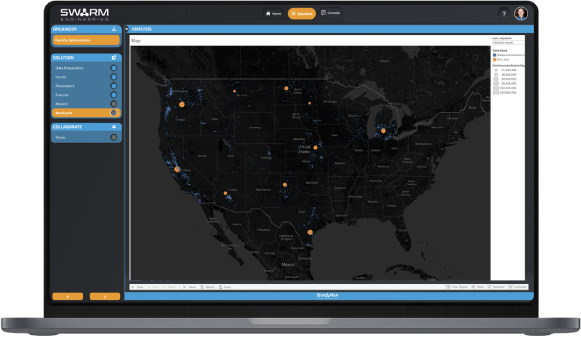
IMPACT
The Q1 2026 window covers January through March. The second window is presented in the SWARM value update as a June 2026 follow-up batch. Each compares the Hendrix’s standard plan with SWARM ENGINE on the same orders for the two lines in Brazil. Hatch of set (HoS) is the percentage of eggs set that result in salable chicks.
1.4% to 1.8% higher modeled revenue: ENGINE produced +1.8% more accepted-order revenue in Q1 and +1.4% more in the follow-up batch than Hendrix’s standard plan. These are separate benchmark comparisons, not an annualized estimate.
1.46 to 1.81 percentage points higher average HoS: Average HoS rose from 32.43% to 33.89% in Q1 and from 31.74% to 33.56% in the follow-up batch. The source reports a 1.81 point June gain; the displayed values round to a 1.82 point difference.
3.5% to 7.3% fewer eggs per female chick: Eggs per female fell from 3.08 to 2.98 in Q1 and from 3.21 to 2.98 in the follow-up batch. In the smaller batch, ENGINE used 15,739 fewer eggs (382,633 versus 398,372), while the deck reports 4,441 more female chicks than Hendrix’s standard plan.
Modeled gains in both benchmark windows
What Hendrix gained by planning with SWARM
Same 25 orders · two Brazil lines · Jan–Mar 2026
Average HoS
+1.46 pts
vs. standard plan
(33.89% vs. 32.43%)
Eggs per female chick
−3.5%
vs. standard plan
(2.98 vs. 3.08)
Female chicks delivered
+15,608
vs. standard plan
(+5.1%)
Order revenue
+1.8%
vs. standard plan
Standard plan: Hendrix's existing planning rules. SWARM ENGINE planned the same 25 orders with the same eggs and capacity. Hatch of set (HoS): the percentage of eggs set that result in salable chicks. Revenue only, costs not included.
The female chick comparisons are against Hendrix's standard plan. These are modeled benchmark results for two genetic lines in Brazil, not measured live production gains.
WHY SWARM
Why ENGINE
fits the planning problem
Joint decisions under capacity
ENGINE evaluated flock choice, egg allocation, equipment use, and accepted orders as one planning problem for the benchmarked lines.
More value from available inputs
The tested plans improved modeled revenue and hatch performance while using fewer eggs per female chick, with equal completed-order counts.
A measured route to production
The proposed next step is a shadow run against a live planning cycle, followed by review of differences and a mutually agreed cutover decision.
can do for
hatchery planning
Discuss how flock performance, eggs, equipment capacity, and order demand shape your planning decisions, and evaluate whether ENGINE can improve outcomes in a benchmark using your own operating inputs.